Earlier in the week, I was going nutty about unearned wealth. The kind that just drops into your lap and you get to spend without reservation. I wasn’t thinking about the then-unwon Powerball lottery, I was thinking about $48,000 in buried treasure.
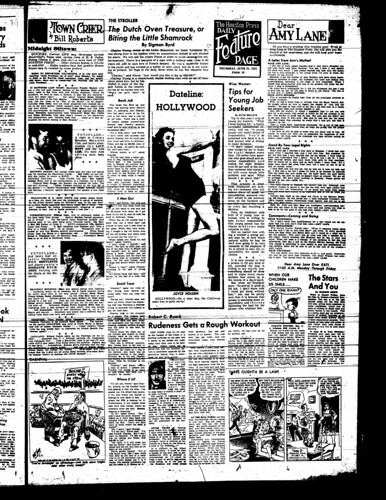
In 1951, Houston Press columnist Sig Byrd wrote of a second-hand account of 1935 bank robbery that resulted in the loot getting buried in the Jefferson, TX cemetery. The great thing is the amount of detail that accompanied the story (the town, landmarks & the nearest gravestone.)
“It was said to be buried in a dutch over at the foot of a cedar tree, near a tombstone inscribed with the name A.D. Kenny…” “besides the T & P tracks” (Texas & Pacific.)
A quick google map search shows in Jefferson, TX, a rail line on the south east border of the Oakwood cemetery. Could this be the place? Not if my resource on the cemetery is correct (and thanks to the internet, I did find an expert on that small town’s cemetery.) But that is for another post. Until then, here is the story in Sig’s own words.


Transcribed Stroller Column: "Sonata in Jump for Four Juke Boxes" by Sig Byrd, Wednesday, March 12, 1952
It was getting towards the shank of the business day, and the Reef (that section of Milam Street from Preston to Prairie) was shutting down.
Or opening up, depending in what kind of business you mean.
At the Goodwill store, northwest corner, Milam and Preston, Carolyn Mason, a pretty brown-eyed girl was about to empty the day’s receipts into a steel cash box, when she saw the shifty-eyed derelict take a 39-cent shirt off the rack, roll it up and stick in inside his shirt.
Being physically handicapped, like all Goodwill employees (she suffered a spine injury in a traffic accident), Carolyn wondered what she ought to do.
Across Preston, the Real Tailors was closing, but the Rose O’Dixie and three other bars were spilling boogie music into the Reef. The sidewalks, both sides, were crowed with people going home and people with no home to go to, black people brown people, white people.
In the 411 Club, the glittering new heart and nerve center of the Reef, owner Bob Griffey, ex-gambler, wearing a yellow sports coat, stood near the cash register, shuffling silver half-dollars like a deck of cards. On his left hand a diamond flashed like a headlight of a locomotive.
Bob felt good. His place was crowded. Not a vacant table, not an idle moment for the brown-skinned waitresses. His customers were dark-complexioned, but they were sports. The left two inched of beer in their bottles, and smoked two-bit cigars.
Bob laughed aloud, but couldn’t hear himself because of the music and voices. He laughed because he knew what the sure-thing boys were saying – that Griffey was flat. Huh! Huh-huh!
Across the Reef, in Prensky’s pawnshop, an ex-night-club bouncer was trying to sell an expensive camera. He was trying to raise train fare home. He was dying of cancer and wanted to die in the town of his birth, not in a Jeff Davis ward.
A bright boy in a purple big-apple cap paused at Prensky’s window, looking at the knives. He wanted to see if there was a knife in the window with a blade longer than the one he had in his pocket. There wasn’t. From the corners of his eyes he watched the white man coming out of the pawnshop carrying a camera. The bright boy wondered how much the camera was worth.
Down at the corner a contact man in a pink sports shirt was waiting for a contact. The contact was late. A yellow-skinned woman passed him and he said, “You seen old Mule Ear?”
I’ve seen him a hour ago,” the yellow woman said. “He was with Two-by-Fo.” The woman hurried across the street. A big dark man in a $150 suit followed her, but she didn’t look back.
In the 411 Club, Bob Griffey passed the deck of half-dollars to his cashier. The cashier, too, was a white man, and he always looked pale next to Bob. Then the ex-gambler turned around and gazed through the fog of tobacco smoke at the murals.
The murals cover three walls of the 411 Club. They were painted by a colored boy named Lemanzel Finley, who wore a beret.
Bob Griffey doesn’t completely trust men who wear berets, but he paid Lemanzel $200 for the job. He wondered if he, Bob, got stung.
The first picture, nearest the door showed a well-dressed, middle-aged colored man hurrying along a city street. Ahead of him three other persons stood against a background of skyscrapers. One was a wavy-haired youth in a zoot-suit with a drape-shape. The second was a slick chick standing on the lid of a large garbage can. Since she wore a tight skirt, the results were arresting.
The third figure was a well-dressed middle aged colored man, wearing a ring set with what Bob supposed to be a zircon.
The series of pictures continued around the walls, and ended near the bar, with an enlarged portrait of an open straight razor.
It seemed to Bob that the pictures told a kind of story, but he couldn’t figure it all out. The wavy haired boy, he decided, was a producer. The man with the zircon was to get shed of the chick. But the rest was cloaked in dark symbolism.
Back in the Goodwill store, Carolyn watched the shifty-eyed man sidle towards the door with the stolen 39-cent shirt Her heart bumped her ribs. He was at the door now. Now he was walking down the street. Suddenly Carolyn picked up the empty steel box and started running. She completely forgot that she couldn’t run. She chased the thief two blocks and told him she would hit him in the head with the box if he didn’t bring the shirt back.
The derelict denied the theft, but he went back to the store. Carolyn followed behind him the steel box ready. She didn’t look up the Reef as she marched him back into the store, but there was a commotion in front of the Rose O’Dixie bar.
Two men were fighting on the sidewalk. A young man and a big dark man. The young man wore a purple cap. In the crowd looking on was a yellowed-skinned woman. She begged the men watching to stop the fight. “He’s got a knife!” She kept saying. “He’s got a knife!”
The police car coming up Milam started to stop at the Goodwill store, where the complaint had come from, but then the man at the wheel saw the crowd on the eats side of the Reef, he drove on, but with out pushing the yellow signal. You can stop trouble in Catfish Reef, but it’s only temporary. It always breaks out again.
Research Project on Middle Bayou Runs Down a Road and To the Preserve: What Oil and NASA Didn't Get, Still Remains
Old Sig Byrd columns are my frequent source for local history. While there is more Houston every year, (let’s hear it for the 4th largest city in the U.S.!) not much of what Sig saw remains. Even 60+ years ago, Sig was lamenting the loss of the city he knew and marveling at the wealth and industry that was building the skyline.
So, surprisingly, it was three columns about wilderness and bayou that piqued my interest. In 1952, Sig wrote about Jimmy Martyn’s 28,000 acre farm, off of Red Bluff Rd. A decade later Humble Oil literally bought the farm. Eventually NASA got some of the Humble property. In the 70’s, preservation efforts stopped further development and the remaining wilderness is now Armand Bayou Nature Center.
The center is where I hope to be on Saturday. A small girl will be in tow, so we’ll see how this trip goes.

“Time Runs Upstream Along Middle Bayou” – The Stroller – Houston Press, Pg. 14 – Friday, January 18, 1952, originally uploaded by Mr. Kimberly.


Sig and the City: From The Houston Library's Microfilm Reader to Your Computer
Lately, I’ve benefited from moderate bouts of unemployment and our daughter’s happy introduction to day care. This has given me some predicable and productive free time. Productive mainly for the fans of Sig Byrd, Houston’s mid-century chronicler of the the local underclass. If he had never strolled the streets, there would be no huge void in the city’s history. But his writing tells parallels tales to the popular take on the city and its developement. Civic boosters must have had a daily conniption, reading about drunken barflys, grifters, the private eye, hitchhikers and many others who are the real-life characters in Byrd’s noir-esque writing.
The Houston Press is archived on microfilm and the I’ve been scanning the 1952 columns for their eventual posting on the Sig Byrd set on Flickr. June through December is on my computer, awaiting titles and other amending before they are internet-ready. 1953 is, to the best of my knowledge, is all there for the reading. I never intended to be be an archivist, but making Sig a subject of research has reduced my sloth slightly and compelled me to visit locales that I wouldn’t have otherwise (Morgan’s Point, TX and Morales Cemetery in North Houston.)
I have hopes these efforts wil evolve into a more formal archive, but until then, Sig’s writings will simply be more accessible to those few who are interested. And that is a good thing.
Rolling With Sig: Driving "Old" Houston
One of my latest ventures has been reading the columns of Houston Press writer Sigman Byrd. Over fifty years ago, he was walking parts of the city that many would avoid if they could. He made a point of getting to know the people and places that would never make history but made for interesting tales. It was in “The Stroller” that he would recount the misfortunes and good news, the sadness and small victories of people that had the deck stacked against them.
With a map of some of the places mentioned in his columns, I drove parts of the city that I never have need to visit. And it was great. A combination of lovely evening weather, only slightly rude drivers and new neighborhoods put me in a great mood.
One thing I felt closer to was why Sig wrote about a city that was so hard on so many people. I drove unfamiliar roads, and would get to a big intersection and see the towers of Downtown. The skyline was a familiar landmark that would appear in the wide streets only to be hidden by passing trees, run down cottages, abandoned storefronts, taco trucks, churches, factories, etc. Around 7pm, the golden hour took hold, and gave the city some extra warmth. I took the one good picture of the evening, and that was good enough for me. It was the cycle of getting lost and finding a familiar and comforting sight that put me a positive spin on my often terrible sense of direction. While I won’t be going through a pair of shoes every couple of months, I hope to put some miles on the car getting acquainted with neighborhoods Sig strolled.

“The King Midas of Smith St.” – The Stroller – Houston Press, Pg. 10 – Friday, Sept. 18, 1953, originally uploaded by Mr. Kimberly.

“The House That Screamed at Night” – The Stroller – Houston Press, Pg. 11 – Monday, July 20, 1953, originally uploaded by Mr. Kimberly.

“Four Underlings of the Tradewinds” – The Stroller – Houston Press, Pg. 11 – Tuesday, May 12, 1953, originally uploaded by Mr. Kimberly.
Also see: Facebook | Sig Byrd’s Houston
 Neon Poisoning