Cabinet Magazine: Amassing the Complete Collection

I started collecting Cabinet Magazine. An odd, satisfying magazine of arcane information, theory and facts. From low-brow and mundane to esoteric and obscure. The need to get the complete collection has taken hold. I’ve got 12 of the 25 published issues (green), leads on 5 issues (yellow) and no info on the remaining 8 (red).

Anyone with suggestions, leads and actual issues for sale feel free to leave a comment.

Issue 1 – Invented Languages
Issue 2 – Mapping Conversations
Issue 3 – Weather

Issue 4 – Animals

Issue 5 – Evil

Issue 6 – Horticulture

Issue 7 – Failure

Issue 8 – Pharmacopia

Issue 9 – Childhood

Issue 10 – Property
Issue 11 – Flight

Issue 12 – The Enemy
Issue 13 – Futures

Issue 14 – Doubles
Issue 15 – The Average
Issue 16 – The Sea
Issue 17 – Laughter
Issue 18 – Fictional States
Issue 19 – Chance
Issue 20 – Ruins
Issue 21 – Electricity

Issue 22 – Insecurity
Issue 23 – Fruits
Issue 24 – Shadows
Issue 25 – Insects

The History that Never Happened: Kymaerica & Dueling Postal Services

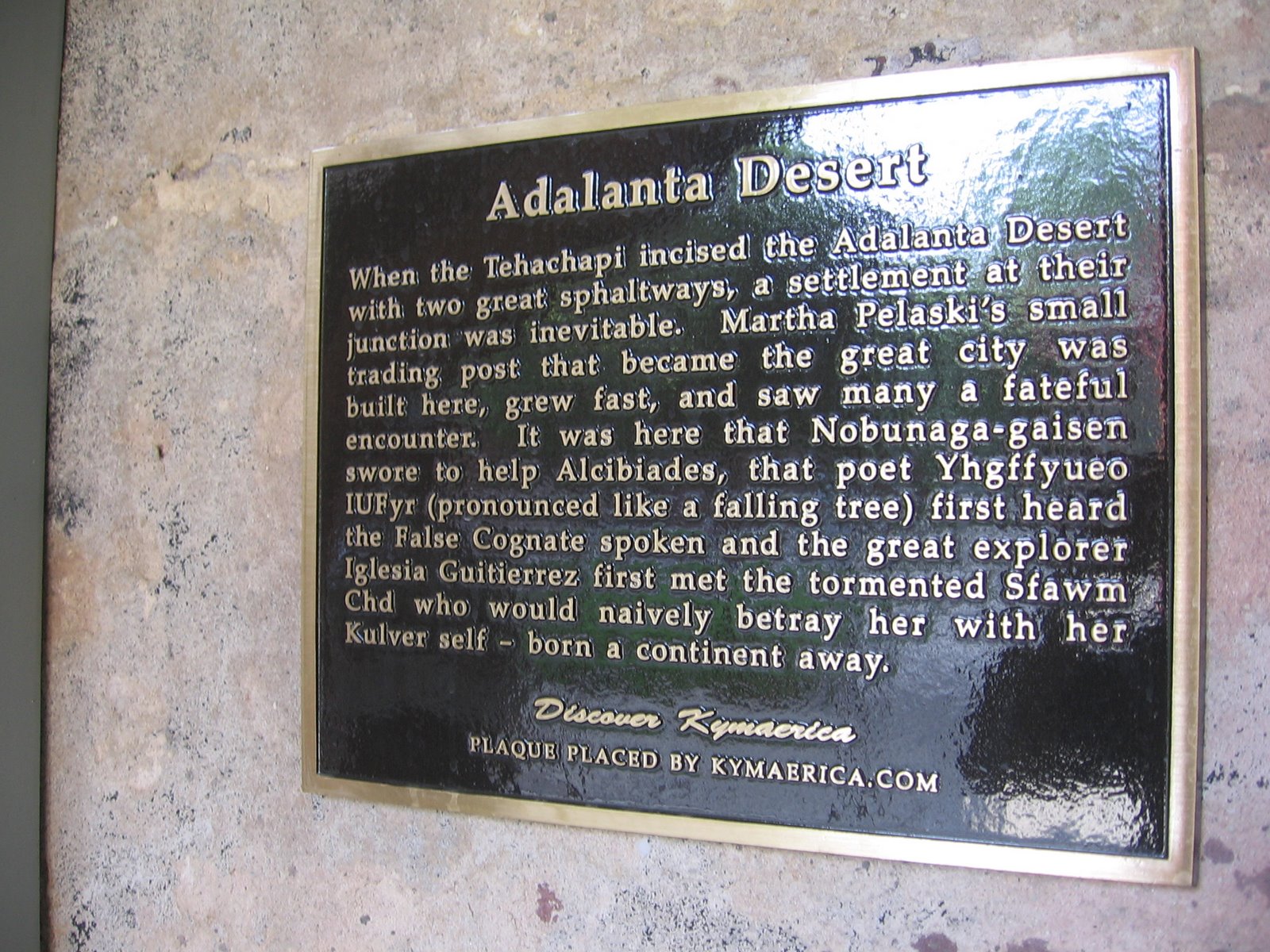
In the lower courtyard where Star Provisions/Bacchanalia are, there hangs a bronze historical plaque. It tells of how the city got its start.

Adalanta Desert

When the Tehachapi incised the Adalanta Desert with two great sphaltways, a settlement at their junction was inevitable. Martha Pelaski’s small trading post that became the great city was built here…”

At first I couldn’t find this plaque. I went to Star Provisions and the nice Brazilian counter guy offered to show me where it was. After leading me to the plaque in the lower courtyard he asked me to explain it to him. He was pleased to be working in a place of historical merit and wanted to know more.

I had to tell him that it was a complete fiction, part of a country-wide project that imagines the North American continent not as it is but as a place full of alternative history. Plaques like this are scattered around the country. Cabinet Magazine’s interview with Eames Demetrios details the people that made up his world.

“There are over 5,000 zones or quasi-nations in Kymaerica. Each one has its own story. For example, there is the Tehachapi, which is the great road building culture in Kymaerica, and they built most of what we now think of as the interstate highways. There are the people who were the original Samurai who were blown off course and settled what we now call Santa Barbara (which they named Hizurokoro). There are the People of the Wind who make buildings totally out of air and who believe that what we call hills are actually depressions in the sky, and what we call valleys are actually hills in the sky. In the area that is present day linear San Diego there is something called the Sandafuegan Fire Cult which puts out valuable possessions and then sets fire to them.”

So, it was in Atlanta/Adalanta that a bit of that historical fiction took place.

Discover Kymaerica
Kymaerica Plaques – a photoset on Flickr

* * * * * * * * * * * * * * * * * * * *

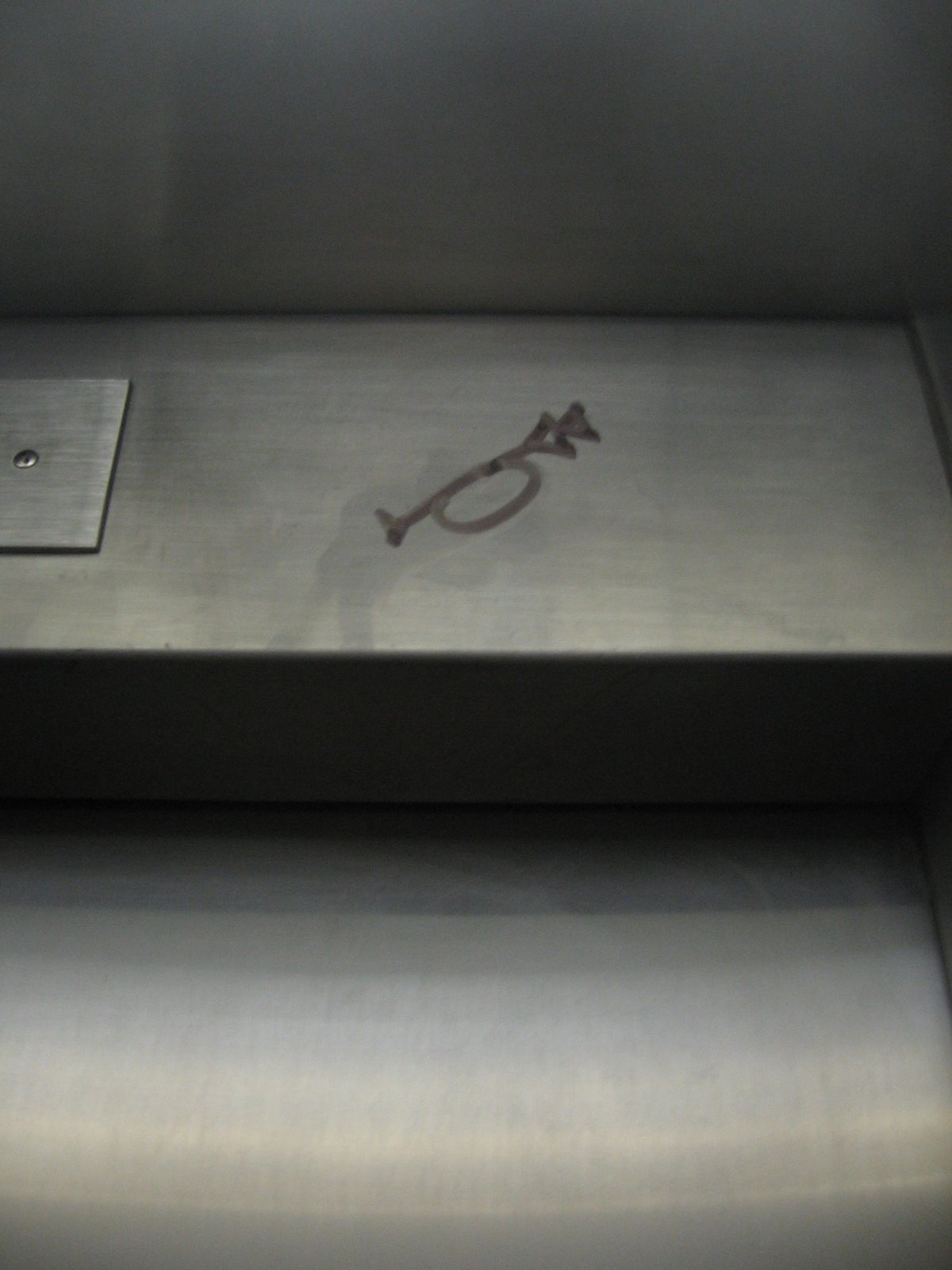
For another bit of alterna-history, there this bit of cryptic graffiti in a Georgia Tech elevator.


The “muted trumpet” is symbolic of a long-standing war between rival postal factions. Taxis was symbolized by a trumpet, the Tyrstero a muted trumpet showing its rival silenced. All of this stems from Thomas Pynchon’s short novel The Crying of Lot 49. While the Tyrstero faction was imagined by Pynchon, Franz von Taxis actually founded the first Italian postal service in the 16th century. Pynchon’s broad and arcane conspiracy appeals to me so it was nice to see a little bit of it in the real world at Georgia Tech.

For additional info: Thurn und Taxis on Wikipedia

Cabinet Magazine, Wundercabinets & Athanasius Kircher

I’ve discovered that my appreciation for anything (music, books, website, etc,) has this cyclical tendency, on-again-off-again. I listen/read/visit, and then I get distracted and put down the pursuits. But often these interests reappear because I’ve found something else that compliment and reinforce something I liked at one time. More times then not I find that I am not alone in my appreciation of what ever has caught my interest.

Cabinet Magazine is one of those things. The magazine issues are collections of arcane facts and stories about people, places and ideas. And being a successful magazine, it must mean I’m not the only one reading about strange and unusual things. Like…

  • King C. Gillette (1855-1932), creator of the disposable razor published a book The Human Drift advocating the creation of a Utopian city near Niagara Falls. Why the Falls? A perfect source of power for his new society.
  • An article on “the Miniature Book Society, an organization whose interests extend only to printed works three inches or smaller.”

  • And much, much more.

Last Monday, I called their NY office and ordered all of their back issues, the most current and got a 1-year subscription. Wednesday all the issues arrived! This is my attempt to surround myself with reading material that will capture my interest and keep me focused. A problem I’ve been having lately. I’m going to continue to attempt to get the remaining issues that were sold-out to complete my collection.

The magazine is influenced by the Wunder cabinet (also Wunderkammer or cabinet of curiosities) . A precursor to museums (which means to excite the Muse) these cabinets or rooms were private collections of natural oddities, things, etc, that individuals would display on their homes.Wundarkammern; cabinets of curiosities, which proliferated in the 16th and 17th centuries. These were usually collections of natural history specimens—skeletons, stuffed animals, fetuses. Sometimes they were ethnographical artifacts, brought from distant lands. Gathered magpie fashion, these cabinets were eclectic, unsystematic and sometimes a bit gruesome.” The Getty Museum in LA has a book, Devices of Wonder, that includes the topic of curiosity cabinets in it.

And lastly, the 17th century Jesuit polymath who much of this oddness orbits around. From the Chronicle of Higher Educations article, Athanasius Kircher, Dude of Wonders

“…The consensus is unambiguous: Athanasius Kircher was, indeed, very cool. A dude of wonders, even. Even a partial catalog of Kircher’s accomplishments tends to make one’s jaw drop. A German-born Jesuit priest, he served as a professor of mathematics at the Jesuit training institute in Rome. Nicknamed ‘the master of a hundred arts,’ Kircher also knew dozens of languages, including Chinese and Coptic. His scientific writings — studied with rapt interest by scholars (Roman Catholic and otherwise) around the world — included works on acoustics, astronomy, chemistry, mineralogy, and optics. He also published some of the earliest scholarship on ancient Egypt…”
Itching for a Trip: The West, Abroad, and Chicago

Me and the missus are wanting to do some travel. The cruiseship work is bringing in some decent bank so a trip may be happening after school ends. The discussion ranges from “The Great American Road-Trip, Part 2” or in an aeroplane over the sea (Everywhere else in the World.)

I’d love another trip to the strange American West to see places like…

The Cabinet National Library in Cabinetlandia, Luna County, NM

Cabinetlandia National Library
Originally uploaded by Sean F.

“Cabinetlandia is located 10 miles east of the town of Deming in Luna County, New Mexico, off Interstate 10 heading east.” – Cabinet Magazine Online –

Official Center of the World, Felicity, California, Felicity, AZ

Center Of The World – 010
Originally uploaded by Homer-Dog.

Center Of The World 2007 – a photoset on Flickr

Salvation Mountain, Niland, California, near the Salton Sea

Salvation Mountain
Originally uploaded by CharlieChu.

As for global travel, as long as being white Americans doesn’t mean immanent danger anything goes. Spain, South-East Asia, India, Croatia, Black Sea, etc. Chances are a cheap airfare to someplace will determine where we go.

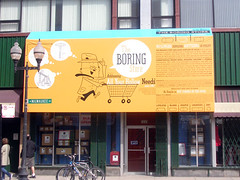
As for Chicago, well that’s a long shot. But The Boring Store would be destination #1.


The Boring Store
Originally uploaded by ScanTheVan.

The store is a combination spy-shop/after-school education program founded by novelist Dave Eggers who also started McSweeney’s Magazine. Read this article for pictures and commentary on what may be the coolest place that “is not a spy store.”

A Few Pictures Taken While out in Atlanta

Yesterday I went to to Youngblood Gallery to see the Ernesto Cuevas Jr. show. Bought a copy of Cabinet Magazine in their boutique store and took a couple of pictures in the neighborhood.